ESKUTE V300 review: this fat-tire electric bike is aimed at riders who want strong assist, broad terrain coverage, and simple daily usability.
If you are comparing an ESKUTE V300 electric bike review against lighter commuter e-bikes, the main question is whether its power and comfort features justify the bulk.
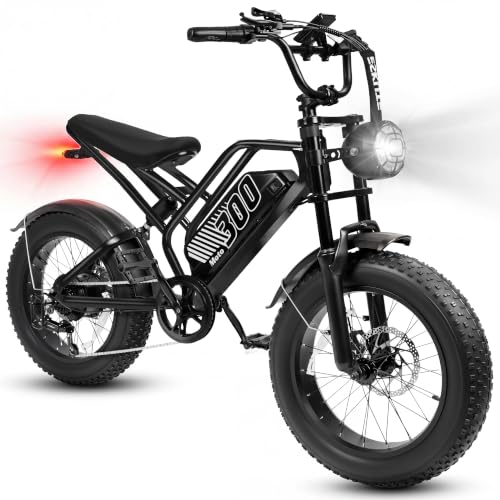
V300 Review Summary
The ESKUTE V300 makes sense for riders who want an electric bike that can handle commuting, mixed roads, and more rugged terrain without feeling fragile or underpowered.
Its pitch is clear: a 1500W peak motor, fat tires, full suspension, and a long-range battery package put it in the lane for beginners, heavier riders, hillier routes, and anyone who values stability over compactness.
Best fit: buyers who want a versatile fat-tire e-bike that can do weekday rides and weekend trail use.
Less ideal: riders who need a lightweight, apartment-friendly city bike or a stripped-down commuter with minimal maintenance.
Review Scorecard
| Category | Score | Buyer assessment |
|---|---|---|
| Motor power | 9/10 | 1500W peak output and 90N·m torque point to strong acceleration and hill capability. |
| Range potential | 8/10 | The 48V 20.8Ah battery is positioned for long rides, though real range depends on mode and terrain. |
| Terrain comfort | 9/10 | 20″ x 4.0″ fat tires plus full suspension are built for rough roads, sand, snow, and mud. |
| Everyday usability | 8/10 | NFC unlock, LCD data, lights, and 7-speed gearing add practical daily value. |
| Control and safety | 8/10 | Hydraulic rear brake and integrated lighting support more confident riding. |
| Beginner friendliness | 8/10 | Multiple riding modes and a clear display make it approachable for new e-bike owners. |
| Portability | 5/10 | The all-terrain setup likely trades convenience for capability and stability. |
Review Scorecard Takeaway
The scorecard points to a bike that is strongest when comfort, traction, and raw assist matter more than low weight or minimalism.
That is the right tradeoff for a rider who wants one e-bike to cover several use cases.
Key Features and Specifications of V300
The headline specification is the 1500W peak motor, paired with 90N·m torque and a claimed 30+ MPH top speed.
That combination suggests the V300 is tuned for confident acceleration rather than casual assist.
The listing also says it can handle up to a 35° climb, which makes the bike more appealing to riders dealing with steep neighborhoods or hilly access roads.
Battery capacity is another major selling point.
The bike uses a 48V 20.8Ah battery, and the listing claims up to 85 miles maximum range.
As with any e-bike, that figure should be treated as an upper-end claim rather than a guaranteed daily result, because terrain, rider weight, assist level, wind, and stop-and-go usage all matter.
Even so, the battery spec is large enough to signal real long-ride intent.
The V300 is also built around traction and comfort.
It uses 20″ x 4.0″ fat tires and a full suspension system, which is a strong combination for loose surfaces and rough pavement.
The listing specifically calls out use on paved roads, mountain roads, snow, and muddy terrain, so the bike is clearly designed as an all-terrain machine rather than a pure city commuter.
Other useful details include:
- Five riding modes: Pure Electric, Pedal Assist, Manual Pedal, Boost, and Cruise
- 7-speed transmission for more control across different terrain
- NFC unlock for keyless start and added anti-theft convenience
- Full-color center LCD showing speed, battery level, mode, and distance
- Hydraulic rear brake for stopping control
- Integrated front and rear lights for visibility
- Ergonomic comfort seat for longer rides
Taken together, these specs show a bike built around capability and convenience rather than simplicity.
The V300 tries to cover a lot of ground, and the hardware matches that ambition.
Pros and Cons of V300
Pros
- Strong power package for climbing, acceleration, and heavier-duty riding
- Fat tires and suspension improve grip and comfort on rough or variable surfaces
- Large battery capacity supports longer commutes and recreational rides
- NFC unlock is a practical anti-theft and convenience feature
- Clear LCD and multiple modes make it easier to adapt the bike to different conditions
- Lighting and hydraulic braking add everyday usefulness
Cons
- Likely heavy and bulky compared with commuter-first e-bikes
- Peak-speed and range claims will vary a lot in real use
- All-terrain design may be more bike than some city riders actually need
- Rear-only hydraulic brake mention leaves some questions about the full braking setup
The strongest pro is that the V300 looks purpose-built instead of watered down.
The main con is the same thing: if you do not need fat tires, suspension, and high power, you may be carrying around features you will rarely use.
Who Should Buy V300?
The V300 is a good fit for riders who want a single e-bike that can handle more than flat suburban pavement.
It makes sense for people with hilly commutes, mixed-surface routes, campground or beach rides, and occasional trail use.
It also looks well matched to beginners who want help from the bike without giving up manual control through a 7-speed drivetrain.
It is especially appealing if you value stability, traction, and simple dashboard-style feedback.
The combination of fat tires, full suspension, and a color display should feel reassuring to riders who are new to e-bikes or coming from a conventional bicycle.
Skip it if your priorities are different.
If you need something light to carry upstairs, store in a tight hallway, or pedal like a normal city bike when the battery is low, the V300 probably overdelivers on hardware and underdelivers on portability.
It also is not the most natural choice for riders who only want a short-range urban commuter and do not care about off-road capability.
Ride and Use Case Analysis
Power for Hills and Loads
The 1500W peak motor and 90N·m torque give the V300 a clear advantage for steep streets and more demanding routes.
That makes it a better match for riders who do not want to arrive drained after a long incline or who expect frequent stop-and-go starts.
Comfort on Mixed Terrain
The 20″ x 4.0″ fat tires and full suspension are the core comfort story here.
They should help the bike feel calmer on cracked pavement, gravel, mud, or sand, and they also support the V300’s role as a do-everything machine rather than a specialized commuter.
Everyday Controls and Convenience
NFC unlock, the center LCD, lights, and multiple assist modes matter because they reduce friction in daily use.
These are the kinds of features that do not sound exciting on paper but make a bike easier to live with, especially if you ride often and want quick status checks and simple startup.
Limits of the Design
The same features that make the V300 capable also make it less elegant for purely urban use.
Fat tires and suspension can add rolling resistance and visual bulk, so buyers should see this as an all-rounder with a strong bias toward comfort and power, not a minimal commuter.
Alternatives to V300
If you want a comparable fat-tire or off-road electric bike, look at the Aventon Aventure.2, Rad Power RadRover, or Lectric XP 4.0.
Each of these lines is known on Amazon and in the broader e-bike market for blending utility with real-world riding range, though their exact setup and ride feel differ.
Choose the V300 if you want the strongest emphasis on fat-tire comfort, NFC convenience, and a high-powered all-terrain spec sheet.
Choose one of the alternatives if you want a brand with a more established commuter-first reputation or a different folding and storage profile.
Is V300 Worth It?
Yes, if you want a powerful fat-tire e-bike that is built for comfort, mixed terrain, and confident assist.
The ESKUTE V300 is most convincing for riders who will actually use the motor, battery, suspension, and traction-focused tires instead of treating it like a basic city commuter.
If that is your use case, it looks like a practical buy.
If you want something lighter, simpler, and easier to store, keep looking.