If you are looking for a stable beginner scooter for a child who is still building balance and steering confidence, this 3 Wheel Scooter for Kids is aimed at exactly that use case.
The design choices are simple and practical: three wheels for steadiness, a wide deck, adjustable height, and light-up wheels that make riding more visible and more fun.
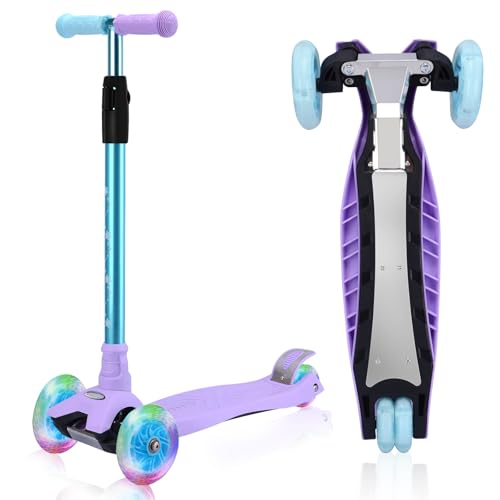
3 Wheel Scooter for Kids Review Summary
This 3 Wheel Scooter for Kids makes the most sense for families who want a first scooter that feels reassuring rather than tricky.
The three-wheel layout, lean-to-turn steering, and stated weight capacity give it a clear beginner focus, while the adjustable handlebar helps it stay useful as a child grows.
It is not trying to be a high-performance scooter or an ultra-compact travel model.
Instead, it leans into confidence, stability, and easy setup.
That is the right tradeoff for many kids ages 3 to 12, especially if the rider is new or cautious.
Review Scorecard
| Category | Score | Why it matters |
|---|---|---|
| Stability for beginners | 9/10 | Three wheels and lean-to-turn steering are built for first-step learners. |
| Growth range | 8/10 | Four height options help the scooter stay useful as kids get taller. |
| Deck and build support | 8/10 | The wide nylon deck and stainless-steel base are positioned for durability. |
| Ride smoothness | 7/10 | ABEC-7 bearings suggest a smoother glide than basic entry-level scooters. |
| Visibility and fun | 8/10 | Light-up PU wheels add visibility and make daytime or dusk rides more engaging. |
| Portability | 7/10 | The removable handlebar supports storage and carrying, but this is still a kids scooter, not a fold-flat commuter model. |
Bottom line: this is a sensible starter scooter with a confidence-first design. If your priority is helping a child learn balance and steering on a stable platform, it is a strong fit.
Key Features and Specifications of 3 Wheel Scooter for Kids
The core selling point is stability.
The listing describes a three-wheel scooter that is more stable than a two-wheel scooter and better suited to first-time riders who are still learning balance and steering.
The lean-to-turn setup is especially important here because it teaches control in a way younger riders can understand.
The scooter also includes a 4-height adjustable handlebar.
The product data says it is designed to accommodate children from about 3 to 13 years old, while the title frames it for ages 6 to 12.
That gap is worth noting: the listing is clearly positioning the scooter as one that can serve a broad age range, but parents should think about their child’s height, coordination, and confidence rather than the age label alone.
The deck is described as a 5.3-inch-wide nylon deck with a stainless-steel base design, and the scooter is said to support up to 154 pounds.
For a kids scooter, that combination matters more than style points.
A wider deck gives a child more room to place their feet, and the stronger base is part of what makes the scooter feel appropriate for everyday riding.
The wheels are another practical feature.
The scooter uses four PU LED light-up wheels with ABEC-7 bearings.
The lighting is partly fun, but it also helps the scooter stand out in lower light.
The bearings are a useful detail because they suggest a smoother roll than the cheapest toy-grade scooters.
Assembly is intentionally uncomplicated.
The listing says the handlebar simply inserts into the deck and locks with red pins, and the handlebar can be removed for storage and carrying.
That is useful for parents who want something that does not require a project to put together.
| Spec | Detail |
|---|---|
| Wheel setup | Three-wheel scooter |
| Steering | Lean-to-turn |
| Handlebar | 4 adjustable height options |
| Deck | 5.3-inch-wide nylon deck |
| Base | Stainless-steel base design |
| Wheels | 4 PU LED light-up wheels |
| Bearings | ABEC-7 |
| Weight capacity | Up to 154 lbs |
| Assembly | Insert handlebar and secure with red pins |
| Storage | Handlebar can be removed |
Pros and Cons of 3 Wheel Scooter for Kids
Pros
- The three-wheel format is naturally more stable for beginners than a two-wheel scooter.
- Lean-to-turn steering helps children learn balance and direction control together.
- Four height settings give the scooter a longer usable life as a child grows.
- Light-up wheels add fun and visibility without requiring batteries in the text provided.
- The deck and base materials are presented as sturdy rather than flimsy.
- The removable handlebar helps with storage and transport.
Cons
- Children who already ride confidently may outgrow the beginner-friendly design quickly.
- The listing language is broad on age range, so fit depends more on the child’s height and skill level than on a single age number.
- It is not described as a folding commuter scooter, so portability is functional rather than premium.
- The strong emphasis on stability suggests it may feel less agile than a fast two-wheel design.
Who Should Buy 3 Wheel Scooter for Kids?
This scooter is best for families buying a first or early-stage scooter for a child who needs stability.
If your child is nervous about balancing, tends to learn by repetition, or is moving up from a ride-on toy, this design makes sense.
The three-wheel format and lean-to-turn steering are both geared toward confidence-building.
It is also a good fit if you want one scooter that can last through a growing phase.
The four height options and stated 154-pound capacity suggest more room to grow than many very basic kids scooters.
Parents who want a light, travel-first scooter or a more performance-oriented ride should probably look elsewhere.
The product is clearly optimized for stability, not speed or compactness.
Likewise, older kids who already handle a standard two-wheel scooter with ease may find this model too beginner-focused.
Ride Feel and Safety of 3 Wheel Scooter for Kids
Stability for New Riders
The scooter’s defining ride trait is stability.
Three wheels give younger riders a broader base, which reduces the awkward wobble that can come with a traditional two-wheel scooter.
That makes it easier to focus on learning steering and braking posture instead of constantly recovering balance.
Steering and Control
Lean-to-turn steering is a smart choice for a children’s scooter because it feels intuitive once a child gets used to it.
Rather than forcing sharp handlebar inputs, the rider shifts weight and learns control through motion.
That is a good teaching tool for first riders and tends to build confidence gradually.
Wheels and Visibility
The LED PU wheels are doing two jobs at once.
They make the scooter more engaging for kids, and they also increase visibility when the light is fading.
The listing does not frame them as a performance feature, so buyers should think of them as a practical plus rather than a reason to buy on their own.
Growth and Everyday Use
The adjustable handlebar matters because scooters are often abandoned when kids outgrow them.
Here, the four height settings and solid weight capacity make the scooter better suited to a multi-season ownership window.
For a household that wants one dependable scooter rather than a series of cheap replacements, that is a real advantage.
Alternatives to 3 Wheel Scooter for Kids
If you want a comparable beginner scooter with a different brand or design emphasis, these Amazon search options are sensible starting points:
- Micro Kickboard kids scooter
- Globber 3 wheel scooter for kids
- Lascoota 3 wheel scooter for kids
- Razor kids scooter
The main comparison point is whether you want a similarly stable three-wheel platform or a more traditional scooter feel.
Micro and Globber are common alternatives for families focused on beginner-friendly steering, while Razor is often worth checking if you want a more familiar mainstream scooter lineup.
Is 3 Wheel Scooter for Kids Worth It?
Yes, if your main goal is to give a child a stable, confidence-building scooter with room to grow.
The three-wheel design, adjustable height, wide deck, and light-up wheels all point to a product that is more about helping beginners succeed than chasing speed or portability.
If you need a first scooter for a child who is still learning balance, this is worth considering.
If your rider already wants something faster, lighter, or more advanced, skip it and move to a two-wheel model instead.