The 42V Scooter Charger is built for one job: charging 36V lithium scooter batteries with fewer compatibility headaches.
If you are trying to replace a lost charger or consolidate several scooter plugs into one unit, this 42V Scooter Charger review covers the main tradeoffs.
Scooter Charger Review Summary
This charger makes sense for riders who want a single, broad-compatibility charger for common 36V lithium scooter setups.
The listing’s biggest strengths are the five included plug types, the UL certification claim, and the simple red/green indicator that keeps the charging routine easy to follow.
It is a good fit if you own one of the supported scooter families or you need a replacement charger and want to avoid guessing at connector size.
It is less appealing if you need a battery chemistry beyond lithium or if your scooter uses a very specific proprietary connector that is not among the five included options.
Review Scorecard
| Category | Score | Buyer-based rationale |
|---|---|---|
| Plug compatibility | 9/10 | Five connector types cover a wide spread of common 36V scooter charging ports. |
| Safety features | 8/10 | UL certification and built-in protection claims add confidence for everyday charging. |
| Charging convenience | 8/10 | 2A output, a long cord, and automatic maintenance behavior keep setup simple. |
| Scooter fit | 9/10 | The listing names many Segway Ninebot ES, MAX, F, and other compatible models. |
| Ease of use | 9/10 | Red/green indicator lights and plug-and-charge operation reduce friction. |
| Buying clarity | 7/10 | The product is straightforward, but buyers still need to match both voltage and connector type carefully. |
Key Features and Specifications of Scooter Charger
The core identity of this product is clear from the listing: it is a 42V, 2A charger for 36V lithium batteries.
That matters because scooter chargers are easy to mismatch, and voltage/chemistry errors are a common reason buyers end up replacing a charger twice.
The strongest practical feature is the included connector set.
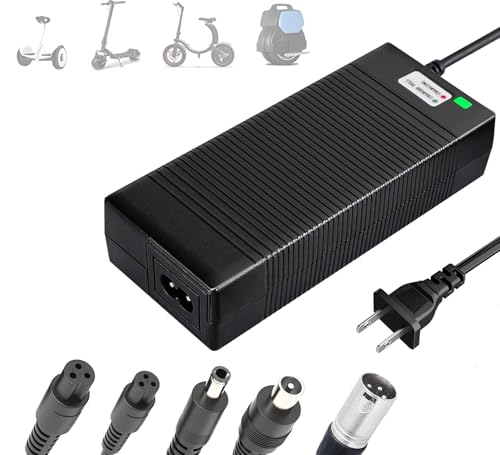
The charger ships with five plug types: 8mm 1-prong, 12mm 3-prong, 5.5mm female DC, 8mm mini 3-prong, and 3-pin XLR.
For buyers with multiple scooters or an older scooter whose port is not standardized, that flexibility can save time and frustration.
The listing also emphasizes safety and status feedback.
It claims UL certification and built-in protection against overvoltage, overcurrent, short circuit, and temperature issues.
It also uses a simple LED system: red while charging and green when full.
Other useful details from the product record include:
- Use case: replacement or universal-style charger for 36V lithium scooter batteries
- Cord length: 9.84 feet
- Maintenance behavior: plugs in and maintains the battery automatically after charging
- Supported examples: Segway Ninebot ES1/ES2/ES3/ES4, E22/E25/E45, F20A/F25/F30/F35/F40, MAX G30/G2, D18E/D28E/D38E/D40X, F2/F2 Plus/F2 Pro, Air T15, E2 Pro, and more
The product is therefore more about broad utility than niche optimization.
It is not trying to be the smallest charger or the fastest charger in absolute terms.
Instead, it aims to be a practical replacement with enough connector variety to cover a lot of mainstream scooter ownership cases.
Pros and Cons of Scooter Charger
Pros
- Five plug types increase the odds that one charger fits your scooter.
- UL certification and protection claims are reassuring for routine home charging.
- 2A output is a sensible fast-charge balance for many lithium scooter batteries.
- The long cord makes placement easier when outlets are inconvenient.
- Red/green indicator lights make charge status obvious at a glance.
Cons
- It is limited to 36V lithium batteries, so it is not a universal charger for every scooter battery type.
- Connector compatibility still needs careful checking before purchase.
- The listing is functional rather than premium, so buyers should expect utility over polished extras.
- The broad compatibility list helps, but it does not guarantee fit for every scooter model.
The tradeoff is easy to understand.
You get flexibility and simplicity, but only if your battery and connector actually match the charger’s intended use.
Who Should Buy Scooter Charger?
Buy this charger if you need a replacement charger for a 36V lithium scooter and want more than one connector option in the box.
It is especially appealing for households with multiple scooters, owners of Segway Ninebot-compatible models, or anyone who does not want to buy a separate charger just because the plug shape differs.
It also makes sense if you value a straightforward charging routine.
The LED indicator, automatic maintenance behavior, and long power cord all point to a charger meant for everyday convenience rather than specialized tinkering.
Skip it if your scooter battery is not lithium, if you are unsure about the voltage match, or if your scooter uses a proprietary charging port that is not covered by one of the five included plugs.
In that case, the safest move is to verify the battery label and connector type first.
Charging Fit and Everyday Use
Connector Matching Matters Most
The five-plug bundle is the defining feature here, but it only helps if you match the plug to the scooter port correctly.
For shoppers who have already lost the original charger, that flexibility is valuable.
For anyone buying on speculation, the safest approach is to compare the battery and port against the listing carefully.
The 2A Output Is Practical
This is positioned as a fast charger with a 42V 2A output.
That is a useful middle ground for riders who want solid charging speed without turning the charger into a complicated accessory.
The listing also says it maintains the battery automatically, which is exactly the kind of set-it-and-leave-it behavior many scooter owners want.
Safety and Status Are Simple
The red-and-green indicator is basic, but basic is often good for chargers.
You do not need app integration or a complex display to know whether a scooter battery is still charging or already full.
The UL certification claim and protection features reinforce the product’s role as a no-drama replacement rather than a novelty accessory.
Cord Length Helps Real-World Placement
The 9.84-foot cord is a practical advantage.
It gives you more freedom to charge from an outlet that is not parked right next to the scooter, which is useful in garages, storage areas, and entryways.
That kind of small convenience often matters more than flashy product features.
Alternatives to Scooter Charger
If you want other well-known options, look at the broader Amazon search results for compatible scooter charger lines such as Ninebot scooter charger, Segway scooter charger, or 36V lithium scooter charger.
Each of those searches can surface chargers with different plug sets, current ratings, or form factors.
If your priority is connector variety, search for universal scooter charger and compare the included plug types carefully.
If your scooter is tied to a specific ecosystem, a brand-matched charger is often the cleaner choice because it reduces the chance of a connector mismatch.
The main comparison point is not just charger wattage or marketing language.
It is whether the replacement truly matches your battery chemistry, voltage, and connector style.
Is Scooter Charger Worth It?
Yes, if you need a practical replacement charger for a 36V lithium scooter and value connector flexibility more than bells and whistles.
The combination of five plug options, UL certification claims, a 2A output, and simple charge indicators makes this a sensible utility purchase for the right scooter owner.
It is not the right pick for every buyer, but it is a strong fit when the question is straightforward: do I need one reliable charger that can cover several common scooter ports? If that is your situation, this 42V Scooter Charger is worth serious consideration.